Search
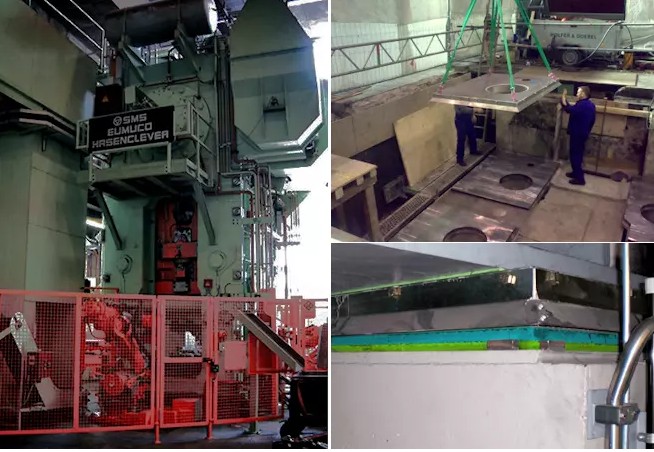
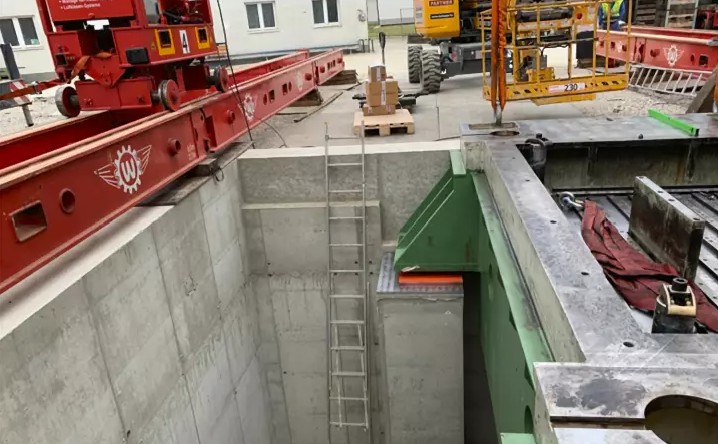
Presses - whether hydraulic presses or forging presses - generate considerable oscillation and shock loads (application) during operation. These affect both the machine itself and its surroundings: Fatigue of elements, noise pollution, basic vibrations, reduced service life, inaccurate results. Vibration isolation of presses with isoloc offers customised solutions to minimise these problems and at the same time increase operational safety, precision and service life.

Advantages of vibration isolation for presses with isoloc
- Significant reduction of shock-like, transient and periodic disturbance forces in hydraulic presses and forging presses
- Improved product quality thanks to stable operating conditions and reduced oscillation influences
- Longer service life of the machine, tools and components by reducing fatigue loads
- Reduction of noise and shakes - both internally (machine) and externally (foundation, surrounding structures)
- Options for compliance with legal and building regulations regarding shakes / immissions
- Flexibility and adaptability: different IPK packages and IPL panels, different load levels, non-linear properties for stability under changing operating conditions
- Cost-effectiveness: reduced maintenance and repair costs, less downtime
What types of oscillation occur in presses?
- Shock-like (transient) vibrations - occur, for example, when the press closes quickly or when tools or workpieces impact. These oscillations have high amplitudes over a short period of time
- Periodic Vibration, - oscillation - repetitive loads, e.g. during cyclical operation, multiple strokes or when operating components such as pump systems. These generate a constant frequency or many harmonic frequencies
- Transient Vibration - free Vibration responses, switch-off processes or sudden load changes that have complex frequency contents and only become established over short periods of time.
- Resonance vibrations / natural Vibration - These occur when frequencies from operation enter into resonance with the natural frequency(ies) of the machine or its installation. Can lead to strong displacements
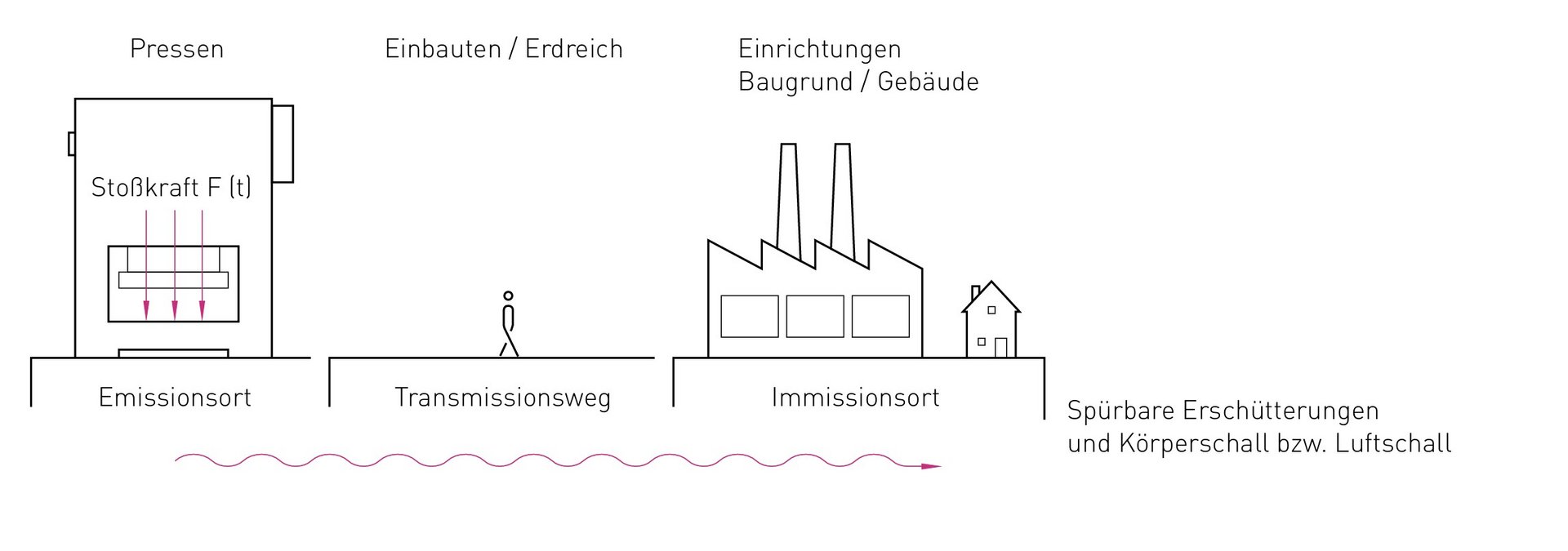
- Oscillations via the foundation / ground transmission - In the case of large presses, especially forging presses, oscillations are also transmitted via the foundation to the ground and thus to the surrounding area, which can lead to immissions (e.g. shaking, noise).